
Health Innovation Program 2026: Accelerating Healthcare Innovation Through Collaboration















AI agents in finance: the customer is moving faster than the bank
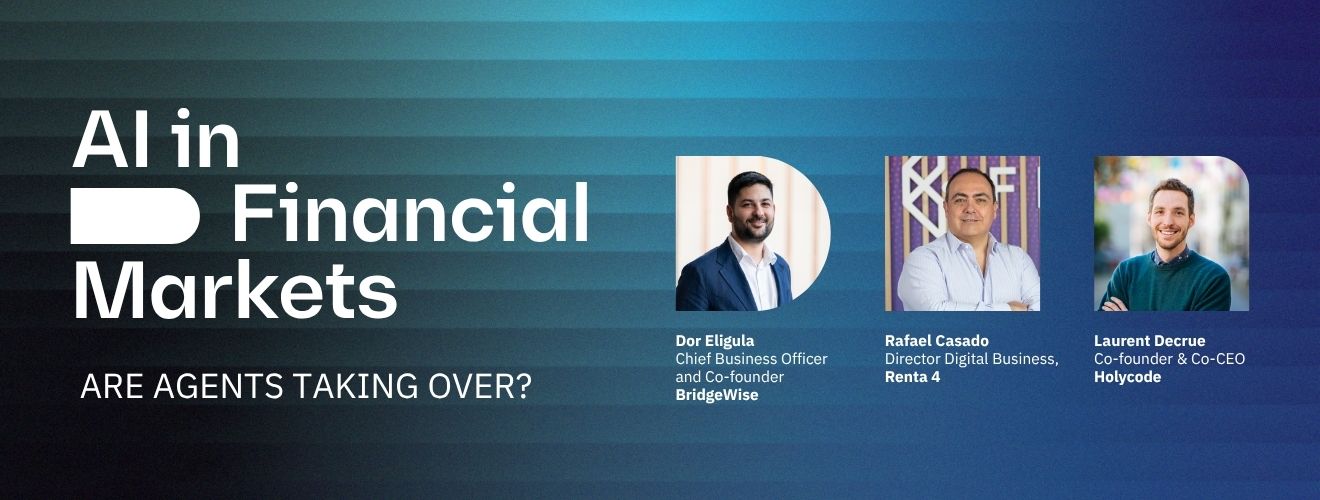
Adoption of AI inside financial institutions is high. Adoption among their customers is higher. That gap set the agenda for the webinar Tenity hosted on 9 September 2026, “AI in Financial Markets – Are Agents Taking Over”, with Rafael Casado, Director of Digital Business at Renta 4 Banco, Laurent Decrue, Co-founder and CEO of Holycode, and Dor Eligula, Co-founder and Chief Business Officer of BridgeWise. Rotem Rubinstein Levy, marketer at BridgeWise, moderated.
AI in Financial Markets – Key takeaways
- Most AI work in financial services is still experimentation. The hard part is production, not the demo.
- Build versus buy has a clear answer for now: partner with someone who has already done it in finance, then bring the knowledge in-house.
- AI readiness is a data and access-rights problem before it is a model problem.
- Customers are already using AI on their bank’s materials, with or without permission.
- Where agents land on retail money splits by segment: decision support for informed clients, fuller automation for the mass market, and both speakers put it inside five years.
- Adoption speeds differ between technology, users, institutions and regulators, and the gap is where customers go elsewhere.
Plenty of proof of concepts, not enough production
Casado’s read on where capital markets actually stand: a lot of talk, a lot of trials, not enough in production.
“There’s a lot of discussion and experimentation going on in the industry. A lot of proof of concepts, a lot of trials, and not enough in production.”
The trials cluster in content generation, marketing, contact centres and research. He was direct about why. The use cases with the most value are the ones that use a customer’s own data, their own transactions and their own content, and those are also the hardest and the most regulated. Which is why the work starts where the data is standard rather than personal: research and market data first, personalisation later.
Decrue, whose company runs around 400 developers doing AI integration work, sees the same pattern from the supplier side, with a reason for it.
“Markets like software development have already gone through a massive transformation. In financial institutions this is happening right now at a slower speed, because it’s regulated, so compliance makes all of it move a little bit slower. I think that’s also a benefit. Because I can tell you, the storm we’ve had to master the last two years was not just fun, but we’ve learned a ton of things.”
The benefit is that someone else went first. Software absorbed the disruption and paid for the lessons, and institutions arriving later can take those lessons without living through it. His caution is that moving from prototype to production still fails often, usually because the first prototype is not good enough and someone internal challenges it, with reason. He also pointed out how uneven the field is. Some institutions can tell within six seconds of you opening your e-banking not just who logged in but whether it is you personally holding the phone, all of it AI-driven, compliant and legal. Others are still struggling to make a password reset link work.
Where he sees production today: internal analysis, software development, data processing, cross-system integration, and a heavy focus on removing repetitive operational tasks. Low risk, internally facing, room for error. Customer-facing is the next step, not the current one.
Build or buy: partner with someone who has already done it
There is a Spanish expression for the distance between a strategy and a working system: going from the muses to the theatre. Casado used it for the build versus buy decision, and his answer put his own engineers on the wrong side of it.
“I would prefer much better to partner with the right specialist than to do things on your own. You have a risk of getting your own teams distracted with this new toy and new technology.”
He compared the moment to the social network boom, when everyone suddenly became a Facebook app specialist, and then to mobile, when everyone became a mobile app specialist. His filter is narrow: the partner has to be specialised, and specialised in finance.
“Don’t partner with someone that is very capable but hasn’t done it. You don’t want a partner to learn with you and then sell that thing to other companies.”
He knows the pull of the alternative himself.
“I’m also a technologist at heart. I would want to get my hands dirty with all these new tools, and it’s so much fun. But we are talking here about creating value for a company. So I have fun on the weekends.”
Outsourcing the build does not mean outsourcing the problem. Casado drew a line between standardised work, content creation or standard data, which is straightforward to hand over, and anything touching your own customers and processes, where the institution has to be involved in the effort itself.
“I would keep it close to the business areas of the company, because there’s a lot of data and processes and facts that are unique to your company that have to be integrated with these new AI. And that’s what is really going to create value for the customer and for the company.”
Partner first, then bring the knowledge in-house
Decrue agreed with one correction, and it is the part most build-versus-buy conversations miss.
“You need to build up the internal AI capabilities. But building this up is a very slow process. Partner, learn from someone that has gone through this a couple of times, bring that knowledge into the company. Don’t buy a SaaS product from them, really partner and transfer the knowledge internally.”
His reason for insisting on the internal build-up is a bet about where software is going.
“In a couple of years, software is mainly going to be AI. So if a company is not looking at strategically building up that know-how internally, I think you’re going to make a mistake.”
The sequencing matters, though. Trying to build it internally from a standing start now puts you well behind the market. Partnering is how you catch up; insourcing the knowledge is how you stay there.
His example: banking clients who cannot send code to external models and need to run on-prem. Rather than build the tooling, they license Holycode’s product, their team is trained on it, and they can run it themselves afterwards. Holycode updates the model in the back, and the client can switch provider whenever they want.
“How do I insource that know-how without being locked into this provider for the next 10 years of my life? Because that’s what happened with all the core banking systems in the past.”
He also argued for a second layer: smaller efficiencies that individual teams try out themselves, with the right frameworks, licensing and tooling to do it compliantly. Teams need room to get their own bloody noses and find out why this is harder than it looks from the outside.
Eligula’s framing of the same point: this is no longer the old SaaS model of take a product and leave me alone. It is an ongoing technology partnership that continues after the first launch. What a specialist brings, on his account, is not only the technology but the experience of having done it under different regulators and business cultures.
BridgeWise operates in 15 countries. He singled out Japan, where financial institutions are extremely risk-averse and detail-oriented to a degree that makes working with AI close to impossible, and where getting it to work took a level of rigour that then benefits everyone else.
AI readiness is a data problem before it is a model problem
Asked what readiness actually looks like, Decrue barely mentioned models.
“A lot of it is really having the right data infrastructure. Reliable data, structured data, adaptable infrastructure that allows you to connect. Security and governance, obviously, and human oversight. And one thing that always gets undervalued is access rights and user roles.”
Get access rights wrong and you have the wrong data in front of the wrong people. He rates most banks as quite good here, better than other industries he works in, and credits regulation for it. His conclusion is blunt: without that groundwork, the choice of partner is irrelevant.
Four actors, four speeds, and the gap between them
Eligula’s framing of why this is hard has four participants moving at different rates. Technology moves fastest. End users adopt next, and fast, because they feel the benefit directly. Service providers, the banks and brokers who own the customer relationship, move slower because they carry the risk. Regulators move slowest, and have to, because they decide what the rest are allowed to do.
The problem is the distance between the first two and the last two. When demand for the technology outruns what an institution can compliantly offer, clients do not wait. They go and get the value elsewhere, in ways nobody has supervised.
That, in his view, is what institutions and startups are jointly responsible for closing: making adoption possible as fast as the demand requires, inside something the institution and the regulator are both comfortable with.
The customer journey is changing with or without the bank
This was the point everyone came back to. Customers are not waiting.
“They are getting our marketing materials and putting it on ChatGPT or on Claude. They are doing it in a not so perfect way, but they are doing it,” Casado said. “It’s not a question about whether AI will impact the customer journey. It’s already impacting how they search, and they moved away from Google into chats.”
He made the timing problem concrete. The EU retail investment strategy looks likely to be approved in November, and then takes 24 to 30 months to implement. Banks are used to those timelines. AI does not run on them.
“Either you do it, or it’s going to be done for you.”
Eligula put the same pressure in commercial terms. If a bank is commoditised, the cost of switching is close to nothing and the willingness to switch is high. Institutions that want to keep the engagement have to move around ten times faster than they are used to.
Casado’s own evidence for why this is certain is closer to home.
“My daughters are the biggest critics of my bank and of any bank. My younger daughter pays for ChatGPT herself. I’m not even paying for it, because of the value she gets out of it for her studies. She expects that same quality of service from any institution: from the government, from the hospital and from the bank. And she’ll get it.”
Decision support or full mandate?
Rubinstein Levy closed with the direct version: how far are we from waking up and having everything run on an algorithm on my behalf?
Eligula’s thesis is decision support rather than delegation. After Covid, more people want to be active and hold the discretion themselves. What he expects is platforms that do the heavy lifting and hand back the call.
“They are providing me the data, the insights that I need to understand, but I make the decision.”
Casado drew a distinction by customer segment.
“For mass customers, I think the agents will take over much more and much sooner. Your description is for the richer or the most sophisticated individuals, the ones that have more knowledge. But there’s a large mass of customers that don’t know, don’t care and don’t worry.”
His timeline for that mass segment: soon, meaning around three years, five at the outside. Eligula put it inside five years too.
Asked separately how AI can take a role in decisions that are shaped by human judgment and news, Eligula started with the purpose rather than the mechanism. The goal is better decisions, not more of them: making a client’s understanding of the decision they are taking better, while avoiding analysis paralysis, which he calls a very big problem in brokers and research across the globe. He is candid that it is a thin line to walk, and says they try to walk it on the data.
The hard part is not the analysis. Eligula does not think an investment decision is a technical one in the first place.
“In fact, it’s very, very, very emotional.”
His example is one of the better documented patterns in behavioural finance, the disposition effect: investors hold losing positions and sell winning ones. What BridgeWise sees in its own client data across markets matches it. Clients find it harder to sell a stock they are losing on than one they are in profit on, even though the position in profit is the one that carries a tax consequence and there are reasons on logic alone not to sell it. They do it anyway.
Eligula’s conclusion: people do not necessarily take wise, logical, technical decisions, they tend to embed the emotions in them.
From the questions: how to test with real customers
One attendee asked how you bridge internal AI testing and testing with real customers before going to full production. Casado’s answer was that the segmentation work has to exist before the deployment does. Know in advance which customer groups are sophisticated enough, critical enough and simple enough to deploy to, and which one you want feedback from.
Then comes the part he says gets skipped.
“Customers don’t like to talk. Only the most vocal ones do, so actually getting feedback from customers is not easy. If not, it’s just a question of, oh, I did a trial, nobody responded anything, and we went forward.”
Eligula added that the listening itself is increasingly a job for the system rather than for people. BridgeWise adapts what it serves at the level of the individual user, based on how that user engages with the modules inside the client’s platform. Someone who uses the chat or the signals gets more of it. His argument is not that humans cannot read the data, but that a person reads it once and an agent reads it continuously, per user.
Decrue closed on what happens to human judgment over time. He cited a study he had read that morning on radiologists who moved from reviewing images themselves to reviewing what an AI flagged. When the system was taken away for a few days, their own pattern recognition had dropped by 15 to 20%.
“By outsourcing the preparation part, maybe our judgment is becoming weaker over time, because we’re not doing the input work that is required to build up this judgment. The benefits outweigh those downsides by a lot at this point. It’s something we need to stay careful about.”
Quotes have been lightly edited from the recording for readability. The study Laurent Decrue refers to was cited from memory during the discussion and is not independently sourced here.