
















Laura Lindström
Program Manager
Discover how eight fintechs from the first Visa Innovation Program Europe Nordics & Baltics cohort mapped a complete payment journey at Baltic Fintech Days.
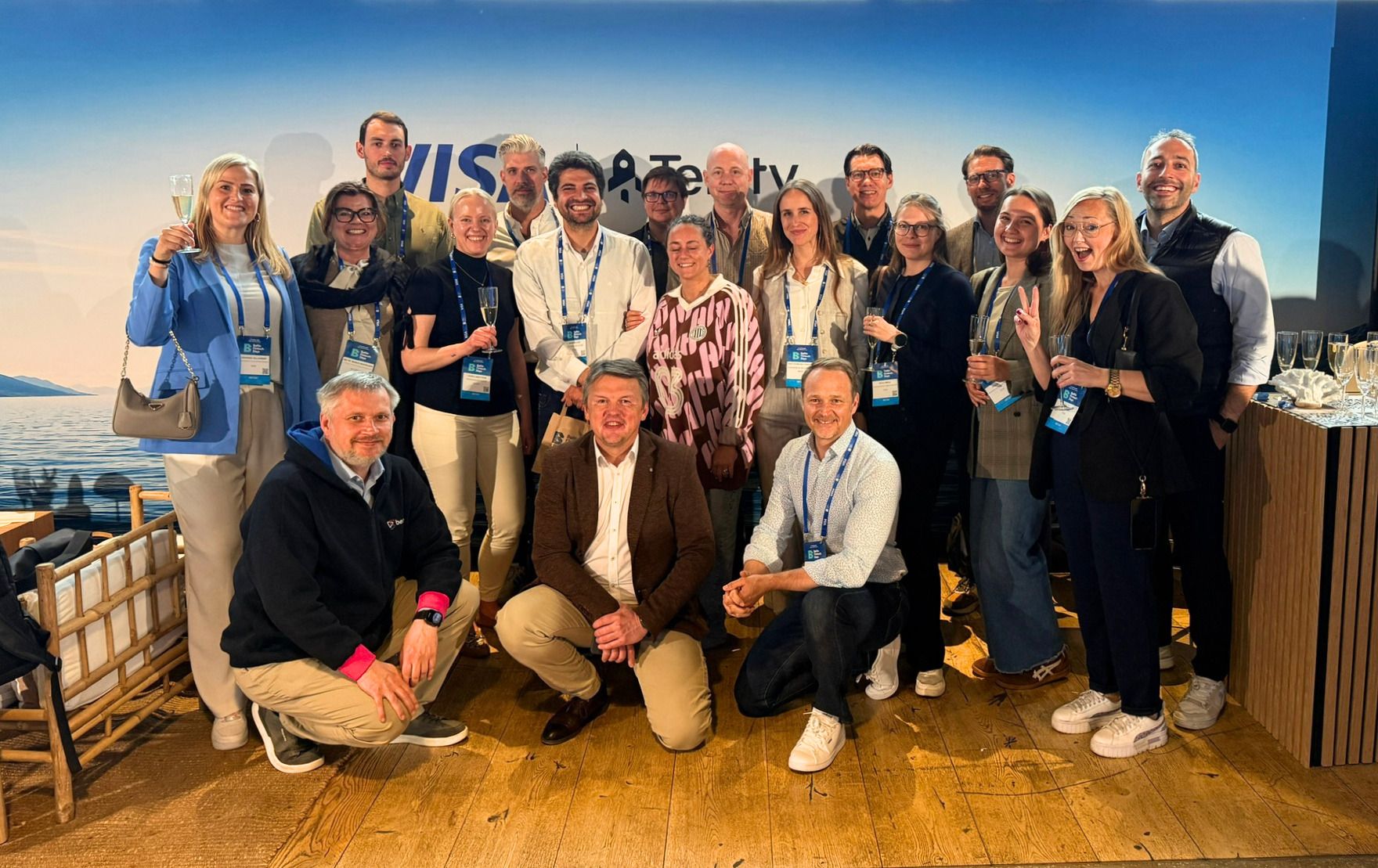
The first-ever Nordics & Baltics cohort of the Visa Innovation Program Europe (VIPE) concluded in Riga during Baltic Fintech Days 2026. Rather than ending the program with a traditional startup showcase, we wanted to do something different.
After all, the eight startups selected for the cohort were solving very different challenges across the payments ecosystem. Some focused on open banking infrastructure, others on spend management, payments, cash flow, expense automation, loyalty, or engagement. Asking each company to deliver a standalone pitch would have highlighted their individual solutions, but it would have missed a much bigger story.
At Tenity and VIPE, we believe fintech innovation does not happen in isolation. The most impactful solutions are increasingly built between startups, financial institutions, technology providers, and ecosystem partners.
This philosophy shaped the Nordics & Baltics program from the very beginning. Rather than taking a one-size-fits-all approach, we worked closely with each startup throughout the six-month program to identify their specific needs, connect them with relevant partners, and explore opportunities for collaboration.
As the cohort approached its finale, we wanted the stage at Baltic Fintech Days to reflect this same collaborative mindset.
Instead of asking eight fintechs to compete for attention through individual pitches, we brought them together to tell one collective story.
The concept was simple: follow a single payment through its lifecycle.
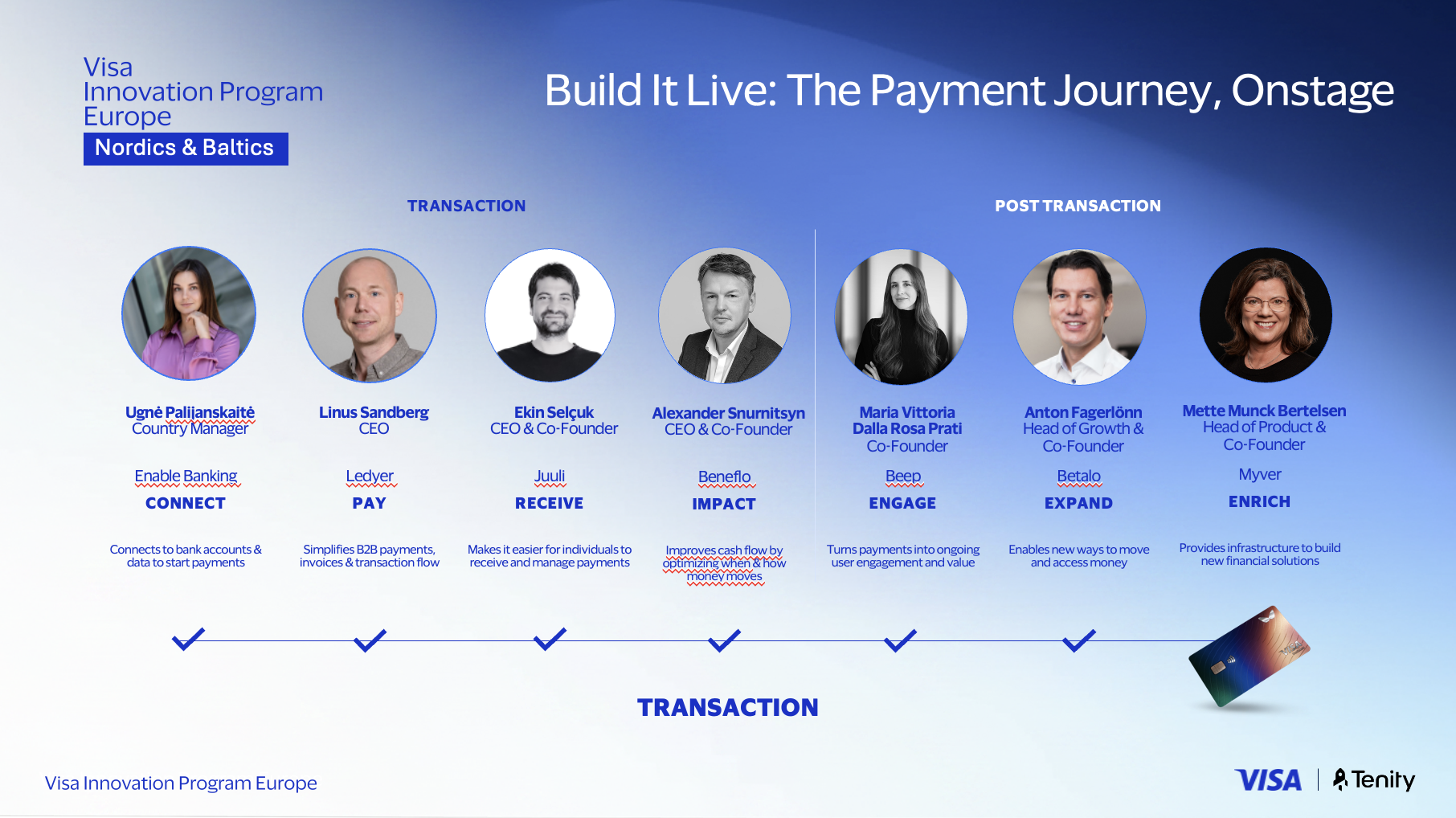
Using a practical example, we mapped the journey from account access and payment initiation through spend control, payment execution, receiving funds, expense management, cash flow optimization, and customer engagement.
In Riga, we were joined by 7 of the 8 selected fintechs for VIPE. Each startup represented a different part stage of that journey:
Enable Banking opened the journey by connecting businesses to bank accounts and payment data to initiate and manage payments.
Ledyer simplified B2B payments, invoices, and transaction flows, helping businesses execute payments more efficiently.
Juuli made it easier for individuals to receive and manage payments, supporting the receiving side of the transaction.
Beneflo focused on impact by helping businesses improve cash flow visibility and optimize how and when money moves.
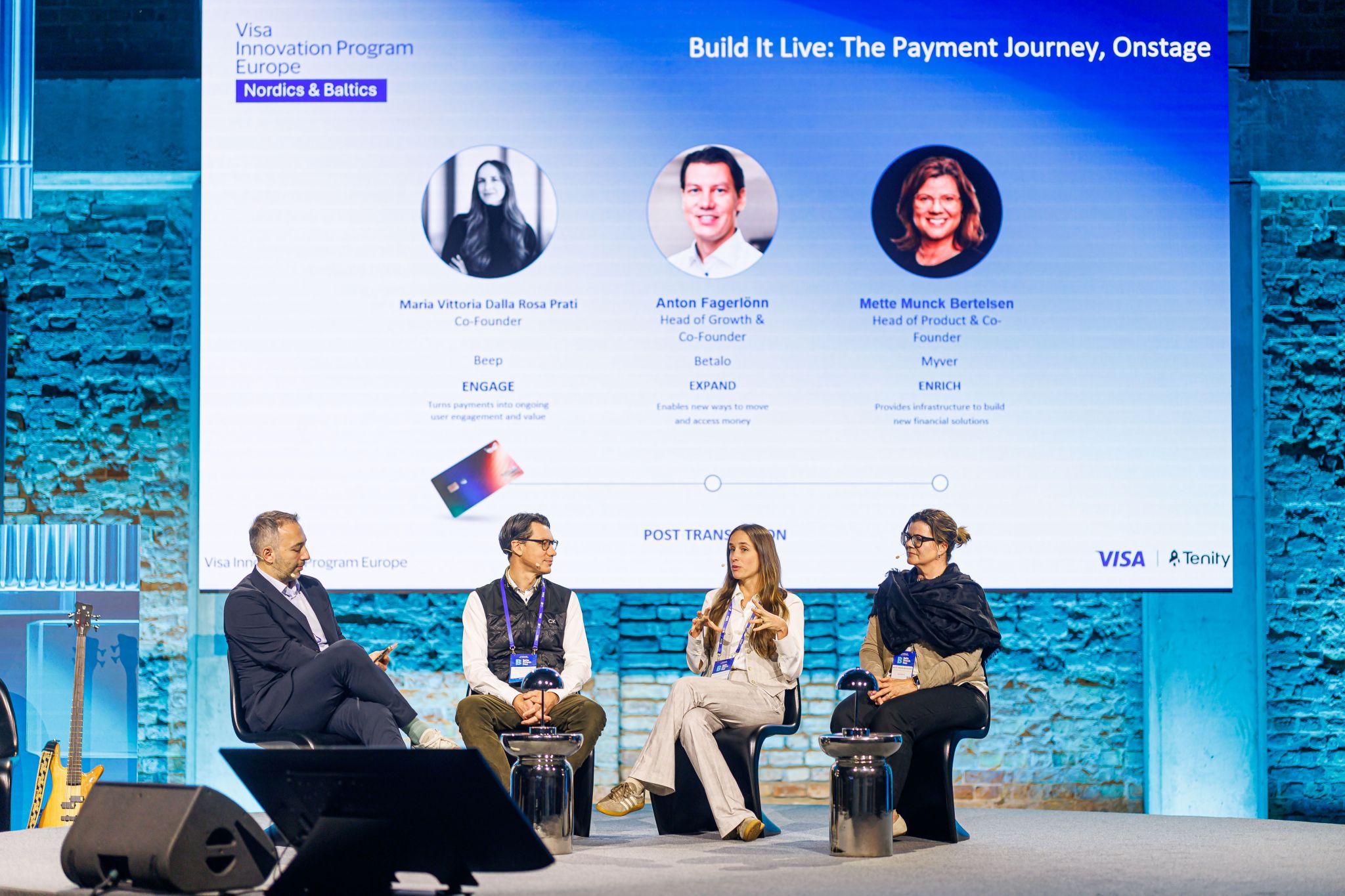
Beep transformed payments into ongoing customer engagement and value creation opportunities.
Betalo expanded access to financial services by enabling new ways to move and access money.
Myver enriched the ecosystem by providing the infrastructure needed to build new financial solutions and experiences.
By placing the companies within a shared payment flow, the audience could clearly see how individual innovations connect to solve larger industry challenges. What emerged was not a collection of separate products, but a broader view of how modern fintech infrastructure is being built.
The format also allowed the startups to showcase their expertise in context. Rather than explaining what they do in isolation, they could demonstrate how their solutions fit into a real-world financial workflow and where they create value for businesses and consumers.
One of the key goals of the Visa Innovation Program Europe is to help startups understand where they fit within the wider payments ecosystem.
For many early-stage companies, success is not only about building a great product. It is about understanding how that product integrates with banks, payment networks, accounting platforms, corporates, and other fintech providers.
The payment journey format brought this ecosystem perspective to life.
As the discussion progressed, it became clear that no single company solves payments on its own. Every stage depends on another. Data enables decisions. Decisions trigger payments. Payments generate business outcomes. Those outcomes create new opportunities for engagement and financial innovation.
This interconnected view reflects the reality of today’s fintech landscape and reinforces why collaboration remains at the heart of successful innovation.
Perhaps most importantly, the format showcased the cohort as a unified group.
Throughout the program, the startups came from different countries, served different customer segments, and addressed different pain points. Yet together they represented a powerful cross-section of innovation happening across the Nordics and Baltics today.
By bringing them together on stage, we were able to highlight not only their individual strengths but also the collective value of the cohort.
The result was a more engaging discussion for the audience, a more meaningful showcase for the startups, and a fitting conclusion to the inaugural Nordics & Baltics edition of the Visa Innovation Program Europe.
The success of the payment journey panel reinforced something we have long believed: the best fintech solutions do not get built in isolation. Collaboration is what turns good ideas into solutions the market actually adopts.
As ecosystems become increasingly interconnected, the most valuable conversations are often not about individual products, but about how different solutions work together to solve real-world problems.
For the first Nordics & Baltics cohort, there could have been no better way to close the program than by demonstrating exactly that.
While the inaugural Nordics & Baltics cohort has come to a close, the conversations and connections created throughout the program continue beyond the final stage in Riga.
Over six months, eight fintechs worked alongside Visa, Tenity, and ecosystem partners to explore collaboration opportunities, refine their solutions, and better understand their role within the evolving payments landscape. The result was more than a showcase of innovative companies. It was a demonstration of what becomes possible when startups, financial institutions, corporates, and technology partners come together around shared challenges.
The payment journey panel highlighted a reality that continues to shape the future of fintech: innovation rarely happens in isolation. The most impactful solutions emerge when different players across the ecosystem collaborate to solve real-world problems together.
⤷ For a broader perspective on the scope and impact of the Visa Innovation Program Europe, explore the VIPE case study here.
⤷ For questions about the program and related initiatives in the Nordics & Baltics region, please contact laura.lindstrom@tenity.com.