
Agentic AI in Financial Services: Turning Vision into Value


















Voice is the new weak spot in bank security
Cloning a voice now takes a few seconds of audio. For banks, a caller is no longer proof of the client, and a call from the bank is no longer proof of the bank. Our Trend Note looks at the rules moving the cost to banks and what startups are building.
The signal
Regulatory attention on deepfakes has so far focused on video onboarding and identity checks: FINMA, for example, recommends technical means to detect deepfakes when accounts are opened online. The phone line has had far less attention, yet it is where many wealth management clients still move large sums. An instruction given by phone to an adviser usually falls outside the in-app confirmation that protects online payments. What protects it instead is a call-back to a registered number and an adviser who recognises the client’s voice.
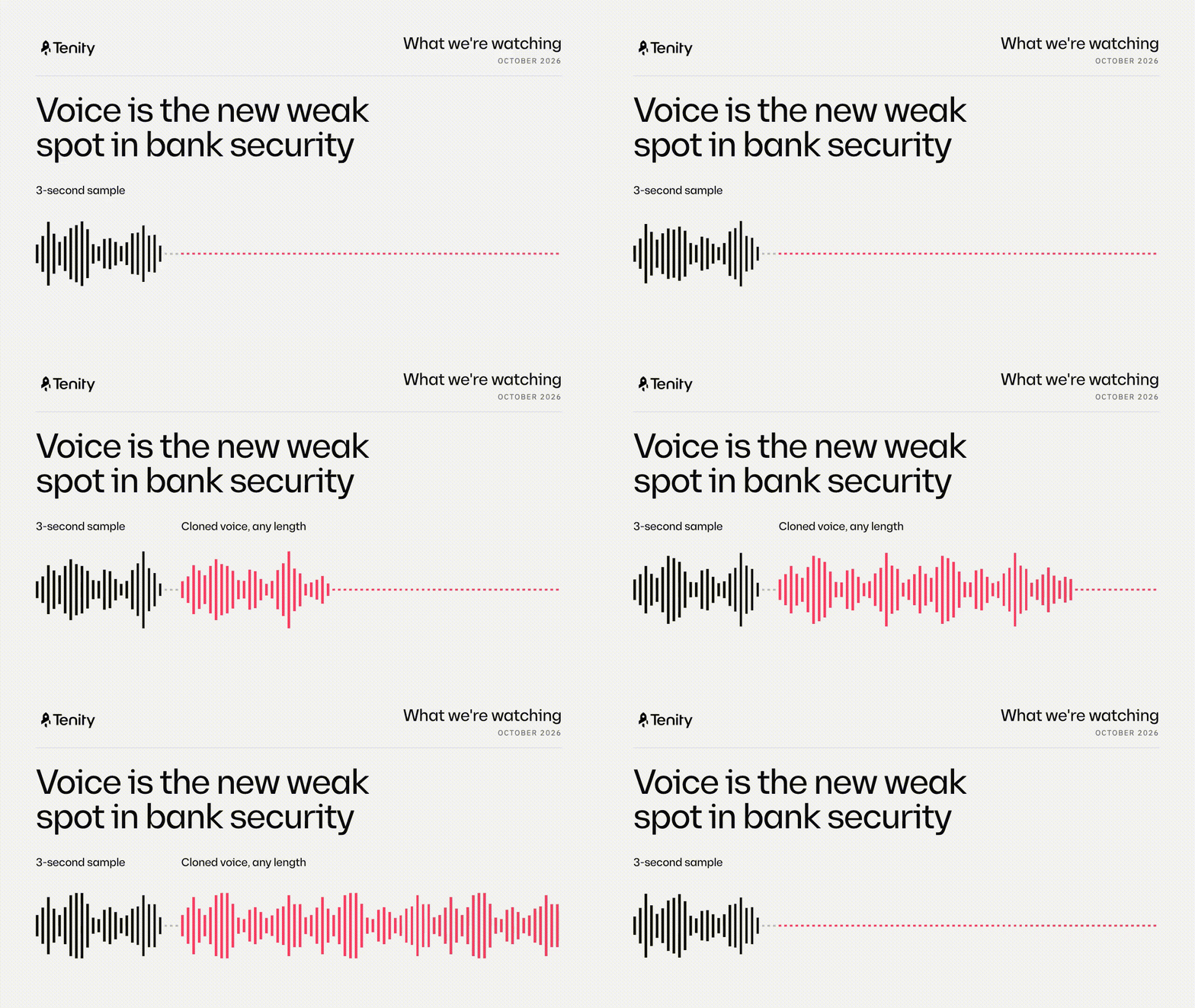
Cloning a voice no longer takes studio recordings. Microsoft Research showed a model cloning a voice from a 3-second recording as early as 2023. The US regulator FinCEN has reported an increase in suspicious-activity reports describing suspected deepfake media, and warns that deepfake audio can be used to impersonate people. A voicemail greeting or a conference clip can be enough.
That changes two things a bank relies on. A client calling in is no longer proof of the client. And a call that seems to come from the bank is no longer proof of the bank. In-app confirmation does not always help here: the fraudster talks the client into approving the payment themselves.
What banks are asking
In our conversations with banks, nobody questions whether voice fraud is real anymore. The question is which detection approach works best.
1 Is this really my client?
Wealth managers need to confirm who is on the line before a large instruction is executed.
2 Is this really us?
Fraudsters now call clients pretending to be bank staff. The bank needs to be able to prove their identity to the client too.
Regulators are moving the cost to the bank
None of the rules below prescribes a specific voice control. What they are doing, market by market, is making impersonation fraud the bank’s problem: either through refunds, through risk-management expectations, and/or by pulling telcos into the chain.
| Market | Rule | Status | What it means for voice fraud |
|---|---|---|---|
| EU | Payment Services Regulation (PSR) | Provisional agreement Nov 2025; final compromise text published Apr 2026; formal adoption pending; expected to apply around 2028 | Once adopted, banks are expected to refund clients who pay after a fraudster poses as the bank’s staff, if the client reports it to the police and the bank, subject to the final text’s conditions and exceptions. Online platforms that fail to remove reported fraud could be liable to the bank. Telecom providers are expected to get duties to help prevent payment fraud, including closer cooperation with banks. |
| EU | AI Act, Article 50 | Applies from 2 Aug 2026; systems already on the market before then have until 2 Dec 2026 for machine-readable marking | Providers must mark AI-generated audio, images and video in machine-readable form, and deployers must disclose deepfakes. Criminals will not comply, so this does not reduce the fraud risk. |
| UK | APP fraud reimbursement | Live since Oct 2024 | In the first year, 88% of money lost to APP scams and claimed back was reimbursed. Banks already refunded most unauthorised fraud; what changed is that scams where the client sends the money themselves are now largely the bank’s cost too |
| Switzerland | FINMA Guidance 02/2026 | Published Apr 2026 | Banks must identify, limit and monitor digital fraud risks; for online account opening, FINMA recommends technical means to detect deepfakes and manipulated videos. 8 of 19 surveyed banks had no dedicated digital fraud policy |
| Singapore | Shared Responsibility Framework | Live since Dec 2024 | Banks and telcos share liability for phishing losses through a fixed waterfall. It covers digital phishing, not calls, but shows where policy is heading |
| US | FinCEN Alert FIN-2024-Alert004 | Issued Nov 2024 | Reports an increase in suspicious-activity reports describing suspected deepfake media, warns that deepfake audio can be used to impersonate people, and asks banks to tag such reports with a dedicated key term |
The direction is clearest in the UK and Singapore, and the EU is set to follow once the PSR is adopted: the bank pays when it could have stopped the fraud, and telcos are being drawn in. Switzerland and the US set expectations rather than refund rules.
Why this is new
Under EU and UK payment rules, banks have long had to refund most unauthorised fraud, such as a stolen card or a hacked account, with exceptions such as gross negligence. Scams are different, because the client authorises the payment, so the loss has mostly stayed with the client. Across the European Economic Area, payment service users bore about 85% of credit-transfer fraud losses in 2024, mainly from scams like these (EBA and ECB). Voice impersonation is exactly this kind of fraud, which is why the UK reimbursement rules and the EU PSR matter here.
What founders are building
Startups are attacking the problem from four angles. None is complete on its own, which is why the strongest setups combine more than one.
| Approach | How it works | Answers | Trade-off |
|---|---|---|---|
| Synthetic-voice detection | Scores live call audio for signs of generated speech | Is this my client? | Must keep pace with every new cloning model |
| Voice biometrics with liveness | Matches a caller to an enrolled voiceprint and checks a live human is speaking | Is this my client? | Needs enrolment; voiceprints alone are increasingly attackable |
| Network-side signals | Telcos see spoofed numbers and call patterns before the bank does | Both | Depends on telco and bank sharing signals |
| Verified calls | The banking app confirms whether the bank is really on the call, so clients can check | Is this really us? | Only covers calls the bank makes |
1 Synthetic-voice detection
How it works
Models listen to the audio stream and look for traces that generated speech leaves behind: unnatural spectral patterns, missing breath and room noise, timing that is too even. Each call gets a live risk score.
Where it fits
Inbound calls to the bank, scored while the call is live.
Ask a vendor
Whether it works on compressed phone audio and in the languages and dialects clients actually speak.
Watch out for
It is an arms race. A detector that is not retrained continuously loses ground with every new cloning model.
2 Voice biometrics with liveness
How it works
The bank enrols a client’s voiceprint, often passively during normal calls, and matches every new call against it. Liveness checks then test whether a live person is speaking rather than a recording or a synthetic voice.
Where it fits
Authenticating known clients on inbound calls, replacing or reinforcing security questions.
Ask a vendor
Enrolment rates, and how client consent is captured and stored.
Watch out for
A voiceprint alone is increasingly attackable: in a widely reported 2023 case, a journalist got into his own Lloyds account through its voice ID using an AI clone of his voice and his date of birth. In the EU, biometric data used to identify a person is special-category data under the GDPR, usually requiring explicit consent; in Switzerland, the data protection authority treats voiceprints as sensitive personal data.
3 Network-side signals
How it works
Telcos see what banks cannot: whether a caller ID is spoofed, where a call really originates, whether a SIM was swapped recently. Banks can query some of these signals through telco APIs in real time; one UK bank ran 3.1 million SIM-swap checks through such an API in March 2024 alone.
Where it fits
Before a sensitive call is accepted, and before a large payment is released.
Ask a provider
Which telcos and countries are covered; latency; how the data is shared lawfully.
Watch out for
Coverage depends on bilateral telco agreements and is patchy across borders. Singapore’s framework makes telcos share liability for digital phishing losses, and the agreed EU PSR text is expected to give telcos fraud-prevention duties, which should make this easier over time.
4 Verified calls and in-app confirmation
How it works
The banking app shows whether the bank is really on the line. Monzo launched this in 2023: a banner in the app confirms when a Monzo employee is on a call with the client, and tells the client to hang up if no one is.
Where it fits
Staff-impersonation scams, the type the EU PSR is expected to make banks refund once adopted.
Ask a vendor
How the client sees the verification; how it works when the client is abroad or on another network.
Watch out for
It only covers calls the bank makes. Clients must learn to check the app, which takes communication, not just technology.
The numbers: 17% of cases and 28% of losses
In UK Finance’s Annual Fraud Report 2026, authorised push payment fraud cases that began via telecommunications were 17% of cases in 2025 but 28% of losses. UK Finance notes these are usually higher-value cases such as impersonation scams, and that the split is based on a subset of cases and not definitive. Online sources accounted for 66% of cases and 32% of losses.
What it means for banks
Whether a bank operates under refund rules today (UK), soon (EU), or under supervisory expectations (Switzerland), three things stand out:
1 Impersonation is becoming a liability line
In the UK, banks already reimburse most scam victims. Once the EU PSR is adopted, they are expected to refund bank-impersonation fraud and carry losses where their fraud controls fall short. What used to be a customer-service issue is moving onto the balance sheet.
2 “Is this really us?” is the less developed half
To check that a caller really is their client, many banks already use voice biometrics, although cloning now undermines them, and synthetic-voice detection is in early deployment. Banks have far fewer ways to show a client that a call really comes from the bank. Verified calls help, but only for calls the bank makes, and only if clients know to check. Most staff impersonation needs no voice clone: a spoofed number and a convincing script are enough. In wealth management, though, clients know their adviser’s voice, and a clone can make a fraudulent call sound like someone they trust. This is also the fraud the EU PSR is expected to make banks refund. A call-back rule for large instructions remains the baseline either way.
3 The telco sees it first
A swapped SIM or a spoofed caller ID shows up on the network before it shows up in the bank. Some of these checks are already available through telco APIs: one UK bank ran 3.1 million SIM-swap checks in a single month. Singapore already makes telcos share liability for digital phishing losses, and the agreed EU PSR text is expected to give them fraud-prevention duties.
Better detection will help, but it will not close the gap on its own. The core question for each bank is: where can a phone call still move money, and what checks the caller there besides their voice?
Sources
- Microsoft Research: VALL-E (2023)
- FinCEN: Alert FIN-2024-Alert004 on deepfake media fraud (Nov 2024)
- FINMA: Guidance 02/2026 on digital fraud risks (Apr 2026)
- EBA Q&A 2018_4058: telephone orders and strong customer authentication
- Arthur Cox: PSD3 and PSR final compromise texts published (Apr 2026)
- Taylor Wessing: EU lawmakers strike a deal on payments reforms (Nov 2025)
- Connect Europe: Telecoms welcome PSR (Nov 2025)
- European Commission: Transparency obligations under Article 50 AI Act
- UK Payment Systems Regulator: One year on, impact of APP reimbursement (Oct 2025)
- Reed Smith: Singapore’s Shared Responsibility Framework (Nov 2024)
- EBA and ECB: 2025 report on payment fraud (Dec 2025)
- IT Brew: Voice-generation AI blows through bank’s voice ID security (Mar 2023)
- General Data Protection Regulation, Article 9
- Lenz & Staehelin: Recent developments in Swiss and EU data protection rules
- GSMA Open Gateway: UK bank SIM Swap case study
- Monzo: Making it clear when we’re on a call with you (Sep 2023)
- UK Finance: Annual Fraud Report 2026 (Jun 2026)