
How to enter African markets: a practical market access guide for startups, corporates, and investors


















The Stablecoin Inflection point: What Tenity’s Roundtable revealed about the future of institutional finance.
Stablecoins have entered their institutional era. At Tenity’s Zurich Roundtable, global leaders from banking, DeFi, infrastructure, and regulation aligned on one message: the future of programmable money is here, decisions made now will determine who leads the next decade of financial innovation.
After years of observing the evolution of digital assets from the periphery of finance to its center, we at Tenity have learned to recognize inflection points when we see them. December 2025 marked such a moment. The Global Stablecoin Roundtable in Zurich brought together the architects of tomorrow’s financial infrastructure—not to discuss possibilities, but to address implementation realities.
What emerged from the day’s three expert panels – on Real-World Institutional Use Cases, Enabling Stablecoin Innovation, and Regulatory Trends for Adoption was not merely a snapshot of current progress, but a clear view of the strategic choices that will determine which institutions, jurisdictions, and ecosystems will lead the next decade of financial innovation.

We are deeply grateful to our partners AMINA Bank, Solana, Solstice, Fireblocks, Steakhouse Financial, and Keyrock as well as the many leading institutions, infrastructure providers, legal experts, and digital-asset innovators who contributed to the discussion.
Why this time is different for Stablecoins
The cryptocurrency industry has produced no shortage of bold claims about revolutionizing finance. Most have fallen short. But something fundamental has shifted in the stablecoin narrative, and Ramzy Ali from the Solana Foundation articulated it with uncommon clarity: we are witnessing the emergence of the financial internet.
The numbers tell a story that cannot be dismissed. Stablecoin supply on Solana has surpassed fourteen billion dollars, with monthly transfer volumes exceeding one trillion dollars. These are not speculative flows—they represent real economic activity, real settlement, real treasury operations. When USDG grew to over 750 million dollars in mere months, becoming a default settlement asset, it demonstrated something crucial: institutional-grade stablecoins can achieve network dominance at unprecedented speed when infrastructure, liquidity, and incentives align.
What distinguishes this moment from previous cycles is technological maturity meeting institutional readiness. Solana’s Token Extensions, local fee markets, and gasless transactions are not incremental improvements – they represent the architectural foundation institutions require to issue regulated stablecoins while maintaining the compliance controls their legal and risk frameworks demand. Performance without permissioning is insufficient. Compliance without composability is limiting. The convergence of both is what makes this inflection point real.
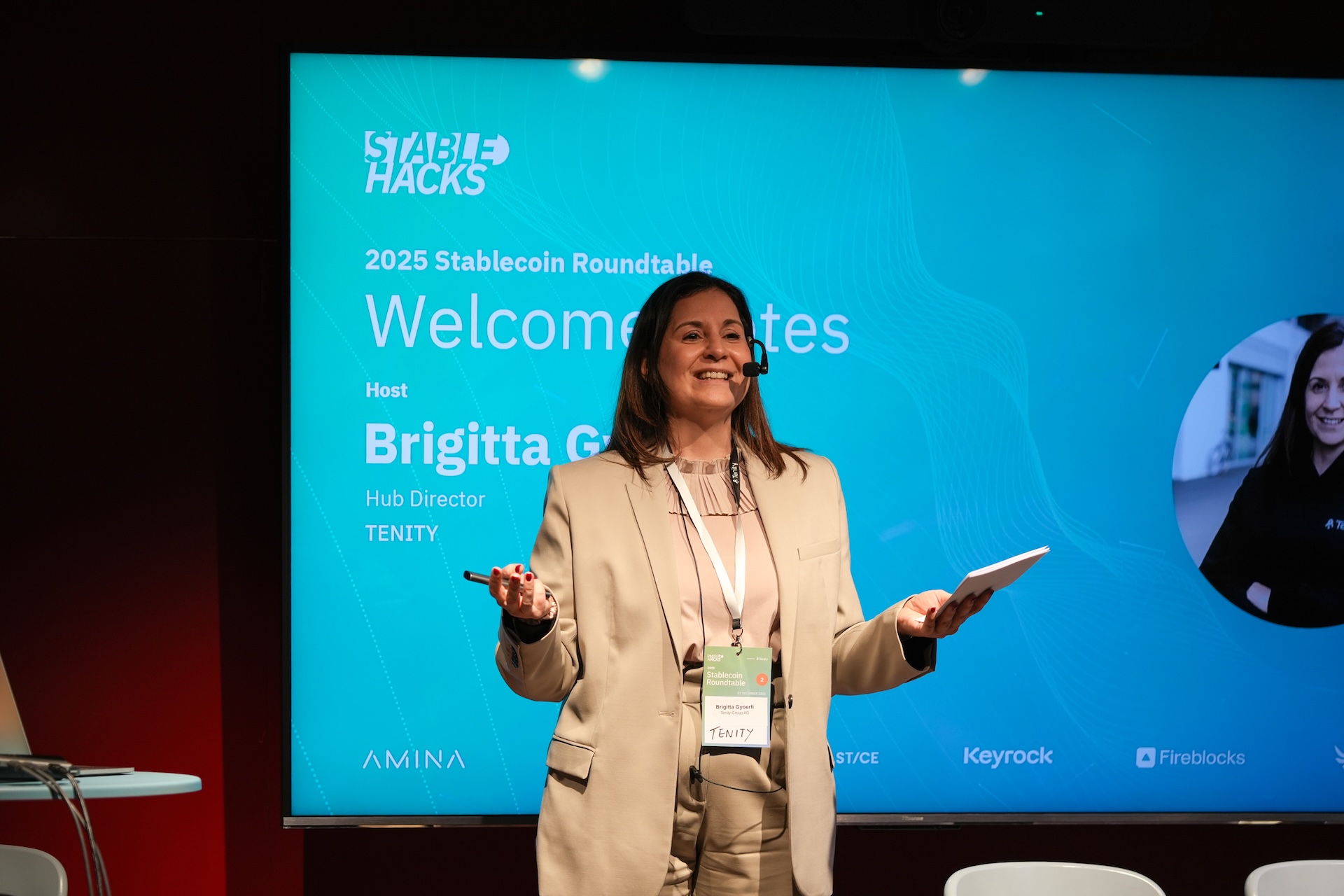
The strategic question banks can no longer avoid: Payments in a Stablecoin World
The most revealing moment in our first panel “Key Insights: Real-World Institutional Stablecoin Use Cases” came not from a celebration of stablecoin efficiency, but from an uncomfortable question posed by traditional financial institutions: if stablecoins enable cheaper, faster payments that move value globally in seconds with dramatically improved capital efficiency, what becomes the future role of banks in payments?
This is not a rhetorical question. It is sort of an existential one.
UBS, AMINA Bank, and Chainlink described the operational reality taking shape: the cash leg is moving on-chain, enabling automated interest payments, redemptions, and lifecycle events. Client demand for on-chain payments and treasury flows is no longer emerging. It has emerged. Payroll can be automated on-chain with rule-based execution. These are not use cases. They are operational realities that challenge decades of banking infrastructure investment.
The efficiency gains are undeniable. The strategic implications are profound. Banks built their payment businesses on information asymmetry, settlement delays, and intermediation fees. Stablecoins collapse these advantages. The institutions that will thrive are those honest enough to recognize this reality and bold enough to reposition themselves—not as gatekeepers, but as orchestrators of more complex value propositions.
Yet candor demands acknowledgment of remaining frictions. Regulatory classification remains unclear for certain stablecoin models. Counterparty onboarding and KYC/AML alignment create operational drag. Fragmentation across blockchains and the absence of standardized technical frameworks slow implementation. But here is what matters: these are solvable problems. They are coordination challenges, not fundamental limitations.
The panelists emphasized what Tenity has long advocated: programmability will define competitive advantage in the next era. Automated lifecycle management, rules-based financial instruments, seamless corporate actions, and new categories of structured products become possible when money is programmable. But realizing this potential requires what the industry has historically struggled to achieve – genuine collaboration between traditional finance, decentralized protocols, regulatory bodies, and infrastructure providers.
No single institution can drive this transformation alone. The winners will be those who recognize that competitive advantage increasingly derives from ecosystem orchestration rather than proprietary control.
DeFi meets TradFi: Beyond the false binary
For years, the industry has debated whether decentralized finance would replace or remain forever separate from traditional finance. The second panel “Key Insights: Enabling Stablecoin Innovation Between DeFi & TradFi” revealed a more sophisticated reality: institutional capital is entering DeFi, but on institutional terms.
The architecture required for this convergence is now crystalizing. Institutions choosing Solana for stablecoin initiatives (as the preferred Layer-1) are making a calculated bet on throughput, latency, and ecosystem maturity. But technical performance is table stakes. What institutions truly demand – and what Kamino, Steakhouse Financial, and Fireblocks each addressed – is transparent, auditable strategies with strict risk parameters, real-time visibility, and dual-mode architectures that preserve permissionless innovation while enforcing permissioned compliance.
Steakhouse Financials’ role as risk curator illuminates an emerging market structure: institutions want DeFi exposure, but only with defensible risk models that survive internal credit committee scrutiny. This is not conservatism – it is fiduciary responsibility. The institutions managing billions in client assets cannot afford to embrace protocols they cannot explain to regulators, boards, and clients.
Fireblocks articulated the infrastructure imperative: enterprise-grade custody with policy-based transaction controls, on-chain monitoring, and compliance workflows embedded into every operation. Institutions can access DeFi composability, but only through architectures that preserve regulatory controls. This is not a limitation. It is the pathway to scale.
What emerged most clearly is that stablecoin yield products represent the natural entry point for institutional DeFi participation. Delta-neutral strategies with historical return profiles, stable collateral structures, and predictable risk characteristics offer what institutions need: yield without the volatility that makes crypto unpalatable to risk committees and compliance officers.
The next twelve months will test whether the industry can deliver on three foundational requirements: standardized permissioned rails, clearer regulatory frameworks, and institutional-grade infrastructure that seamlessly integrates custody, identity, and protocol-level risk safeguards. The organizations building these capabilities now will capture disproportionate value as institutional capital flows accelerate.
Switzerland’s strategic crossroads in Institutional Stablecoins
The final panel “Key Insights: Regulatory Trends & Strategic Levers for Institutional Stablecoin Adoption “delivered the most uncomfortable insights of the day – and perhaps the most important.
Switzerland risks losing its position as a global crypto leader. This assessment, shared across panelists with remarkable consistency, should serve as a wake-up call. While Switzerland’s early regulatory leadership through the DLT Act, FINMA’s foundational clarity, and progressive sandbox frameworks established global standards, the current regulatory tempo appears insufficient relative to developments in Europe and the United States.
MiCA now provides more actionable guidance for stablecoin issuance, custody, and reserve governance than FINMA has released. The EU’s ART and EMT licenses create a clear pathway for institutional stablecoins. Emerging US bipartisan proposals could soon establish a dedicated federal framework for stablecoin issuers. Meanwhile, Swiss regulation remains principles-based but insufficiently adapted to stablecoin operational realities.
Switzerland must accelerate regulatory clarity on stablecoins to avoid losing its competitive edge.
Clear, purpose-built regulation has become a competitive advantage. Jurisdictions that provide certainty will attract capital, talent, and innovation. Those that maintain ambiguity will watch these assets flow elsewhere.
The panel explored a delicate balance: regulators rightly expect permissioned governance structures, reserve transparency, auditing rigor, and identity layers for institutional use. But overly restrictive interpretations risk stifling the programmable finance innovations that make stablecoins transformative rather than merely digital versions of traditional instruments. As LEXR emphasized, Switzerland must enable permissioned models without foreclosing DeFi-enabled experimentation.
Banks face their own strategic clarity deficit. Should they issue stablecoins, focus on custody and tokenized deposits, serve as gateways to DeFi, or pursue multiple roles simultaneously? BCG highlighted that institutional demand is genuine, but product design hinges on regulatory clarity about permissible activities. Lawside LLC noted that fundamental questions about reserve treatment, redemption mechanics, and liability allocation remain unresolved.
The timeline for these decisions is compressing. The next twenty-four months will determine whether Switzerland leads or follows in the stablecoin era. The world is moving toward cross-border regulatory alignment, global standards for auditability and reserve management, and integration of stablecoins into capital markets, payments, and treasury operations. Switzerland possesses the talent, institutions, and infrastructure to lead. What remains uncertain is whether it possesses the regulatory ambition and speed required to capitalize on these advantages.
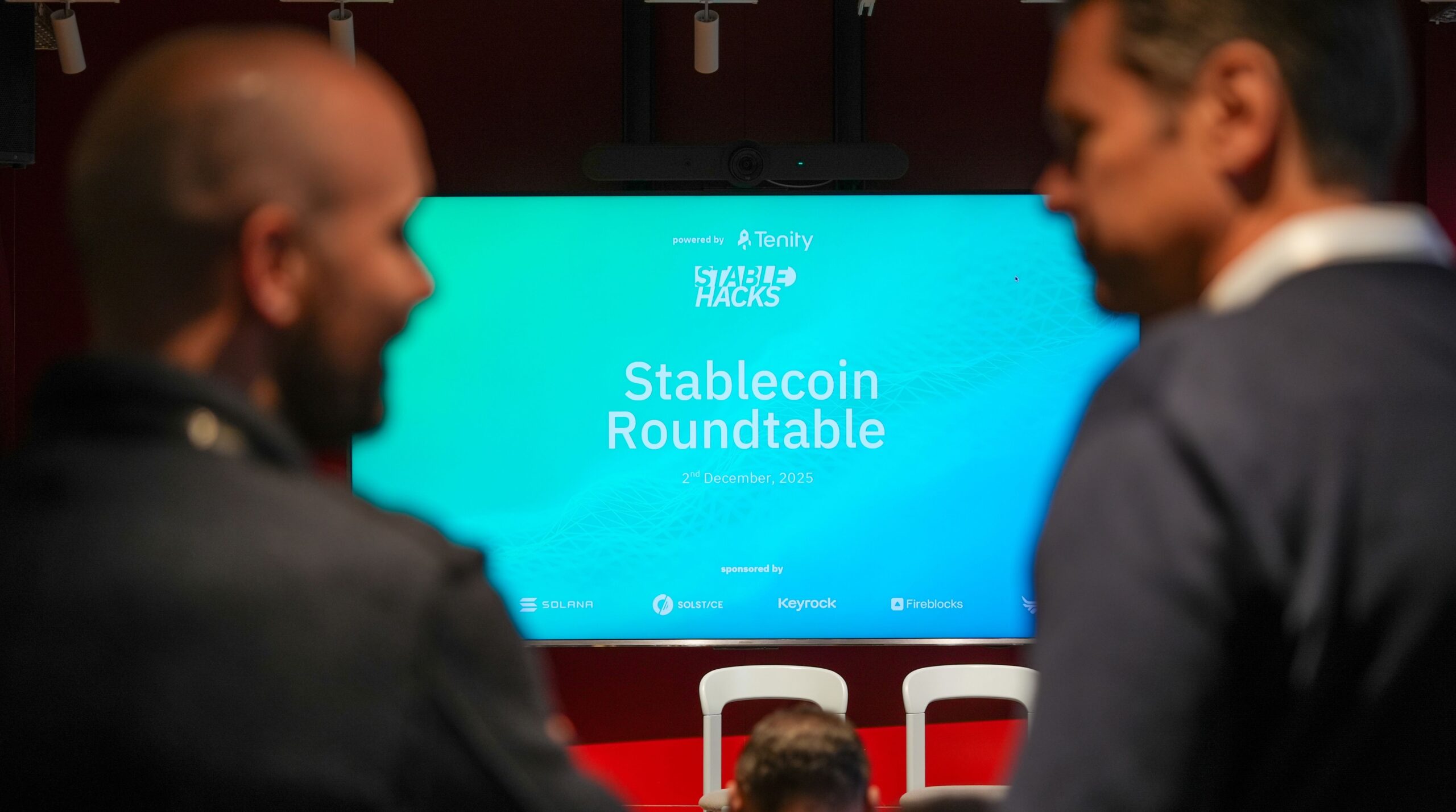
What Tenity has learned. And what comes next.
Having supported hundreds of financial institutions and fintechs through digital transformation, we recognize patterns. This Roundtable revealed all the hallmarks of a genuine inflection point: technological capability has outpaced institutional adoption, but institutional interest has now caught up. Regulatory frameworks lag both technology and demand, but are accelerating. Early movers are establishing network effects that will be difficult for latecomers to overcome.
The strategic imperatives are clear. Institutions must move beyond pilots to production, accepting that stablecoins will restructure payment economics whether incumbents participate or not. Technology providers must deliver not just performance, but the permissioned architectures, risk frameworks, and compliance tooling institutions require. Regulators must provide clarity that enables innovation rather than merely managing risk. And ecosystems must collaborate across traditional boundaries, recognizing that interoperability and standardization create more value than proprietary fragmentation.
The institutions that thrive will be those that recognize a fundamental truth: stablecoins are not a product category. They are infrastructure for programmable money. The opportunities lie not in issuing tokens, but in orchestrating the complex value chains, risk management frameworks, and ecosystem relationships that make programmable money useful at institutional scale.
Switzerland has the talent, institutions, and infrastructure to lead but must act decisively.
This is why we are launching the Global Stablecoin Hackathon – StableHack – designed to accelerate the development of real-world stablecoin solutions for institutional adoption. Organized in collaboration with AMINA Bank and Solana as co-hosts, with Solstice serving as the challenge partner, along with Keyrock, Fireblocks, and Steakhouse Financial supporting as ecosystem and community partners, StableHack represents our commitment to moving from discussion to deployment.
The questions posed in Zurich demand answers. How do we complete the on-chain settlement loop? What does permissioned DeFi architecture actually look like in practice? How can banks safely access stablecoin yield while satisfying their compliance frameworks? What identity and risk management layers enable institutional adoption at scale?
StableHack exists to accelerate answers to these questions. The future of finance will be built by those who act while others deliberate. We look forward to discovering what the community creates and to supporting the solutions that move institutional stablecoin adoption from possibility to reality.
Join us in building the institutional stablecoin ecosystem.
To explore partnership opportunities, contact Brigitta Gyoerfi, Hub Director Switzerland at Tenity.
Email:brigitta.gyoerfi@tenity.com
Telegram: @brigitta_g