Megan Chau: Chasing product excellence, enduring the grind, and transforming risk in Asia


















Construction fintech: how Renno fixes broken trust
Renno co-founder Mark Slaughter on fixing broken trust between homeowners and builders, starting with payments and where Renno goes next.
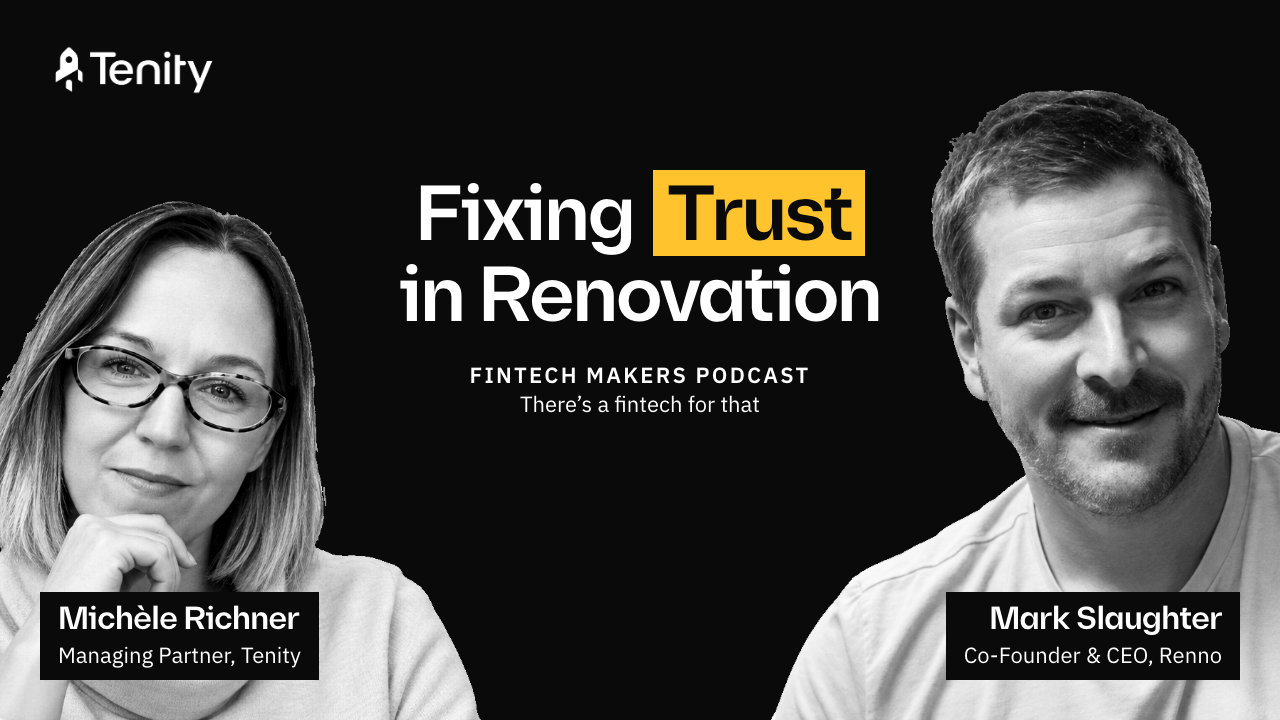
Tenity Fintech Makers Podcast – Episode 1 with Renno
I thoroughly enjoyed this conversation with Mark Slaughter, CEO and co-founder of Renno. It takes us into a vertical that rarely gets airtime: renovation and maintenance. The size of the market should catch anyone’s attention on its own and the customer is just as interesting.
What stayed with me is the feedback loop Renno is building. The product team spends most of its time talking to builders and homeowners, hundreds of them, on both sides of the transaction. That gives them a lot of insight to draw on, so product and positioning decisions rest on what customers say, not on what the team thinks makes sense. It’s how Renno is building a two-sided marketplace where both sides work for each other instead of against each other.
We also got the origin story. Mark’s own renovation of a historic house in Amsterdam turned into a nightmare, and that experience took him from a healthcare and biotech career into construction fintech.
The rest of this piece looks at the trends behind the conversation: what vertical fintech looks like in practice, and how Renno goes to market and keeps learning from its users.
Why is renovation fintech’s overlooked vertical?
Renovation and maintenance doesn’t come up much in fintech conversations, yet ING Research puts the EU market at around 850 billion euros a year. That covers all renovation and maintenance, including non-residential work. Renno works in the residential part: homeowners hiring a builder for a kitchen or an extension.
On one side is a homeowner making what Mark calls the biggest transaction a consumer will ever do outside of buying a house, and “it’s highly unregulated, it’s offline and there’s broken trust.” On the other is a small builder for whom, as Mark puts it, “if you’re not swinging a hammer, you’re not making money.”
Mark came to this as a client himself. He bought a house on the Amsterdam canals that dates from 1562, and hired the architect’s brother-in-law to help knock a couple of apartments into one. That builder took a 25,000 euro deposit and barely showed up. Mark had little recourse, since going after him would have cost more than the deposit. The next builder started demolishing parts of the house, which is a protected monument, after a miscommunication with a subcontractor. That brought in the city and the historical society, and another large chunk of cash vanished. A third, rescue builder saved the house, and he is one of Renno’s good clients today. A project that should have taken six months took more than two years and cost 50 to 60% more.
That third builder was in Mark’s home for two years, and he showed Mark what the process looks like from the other side. In the middle of Mark’s project, one of his other clients went bankrupt and left him on the hook for around 140,000 euros of materials and labour. For a company of three people, that’s catastrophic. He had to take out a personal loan to cover it just as he was applying for his first mortgage, which hurt his ability to borrow. He was building everyone else’s dream homes and couldn’t get his own family on the property ladder, and Mark says it “just screamed so unfair.”
Mark and his co-founder then spent about six months talking to hundreds of builders. What they found is that it’s precarious on the builder’s side: “every client they take on can financially bankrupt the business.”
Why have construction software startups struggled?
SaaS for construction is nothing new. Mark calls the result “a quite large graveyard of construction SaaS companies.” Most of them tried to take enterprise software and fit it to small owner-operators, but it just doesn’t translate. The reason, Mark says, is that “they try to own the workflow versus the payment flow.” Workflow tools help with managing teams and communication.
Mark says that’s “not as deadly of a pain point as the payments.” What’s collapsing these businesses is how long it takes to get paid. Construction has more company insolvencies than any other sector in England and Wales, about 17% of the total according to Insolvency Service figures, and Mark says what drives them is a lack of cash flow.
For independent builders the impact is even higher: in the 12 months to October 2025, about 23% of self-employed and trader bankruptcies in England and Wales were in construction. “That’s exactly why we exist.”
Builders are also the part of the economy Mark calls the most neglected when it comes to financial tooling. They’re too small for enterprise software and too financially unpredictable for the big high street banks. Factoring is the usual answer to slow payment, but the fintechs that offer it have moved towards big civil projects like bridges, hospitals and stadiums, and the small builders are left out.
Timing helps too. Three or four years ago, you’d have had to get your own e-money licence in Europe, then another in the UK, then one in every other country you wanted to enter. Now you can rent them, along with the infrastructure they run on, so Renno builds its own product on top. Mark also points to the push to renovate Europe’s old, drafty housing stock, and to a younger generation of builders who already run much of their lives through apps.
Go-to-market: homeowners pull, builders pay
Mark says the closest analogy for Renno is Airbnb: “homeowners are our acquisition engine and builders are our business model.” A homeowner might only renovate once or twice in a lifetime, but each one tells 10 to 12 people, and about half of those are thinking about something similar. Many come to Renno with the cash and the architectural plans, asking for help finding a builder they can trust.
Builders are the repeat customers. Renno sends good jobs from those homeowners to the builders in its network, and for a good builder who’s still on the fence, the first one is on Renno. After that it’s up to Renno to keep creating enough value that builders bring their own customers back, over and over. Mark says both flywheels are spinning, though sometimes one is going a little faster than the other.
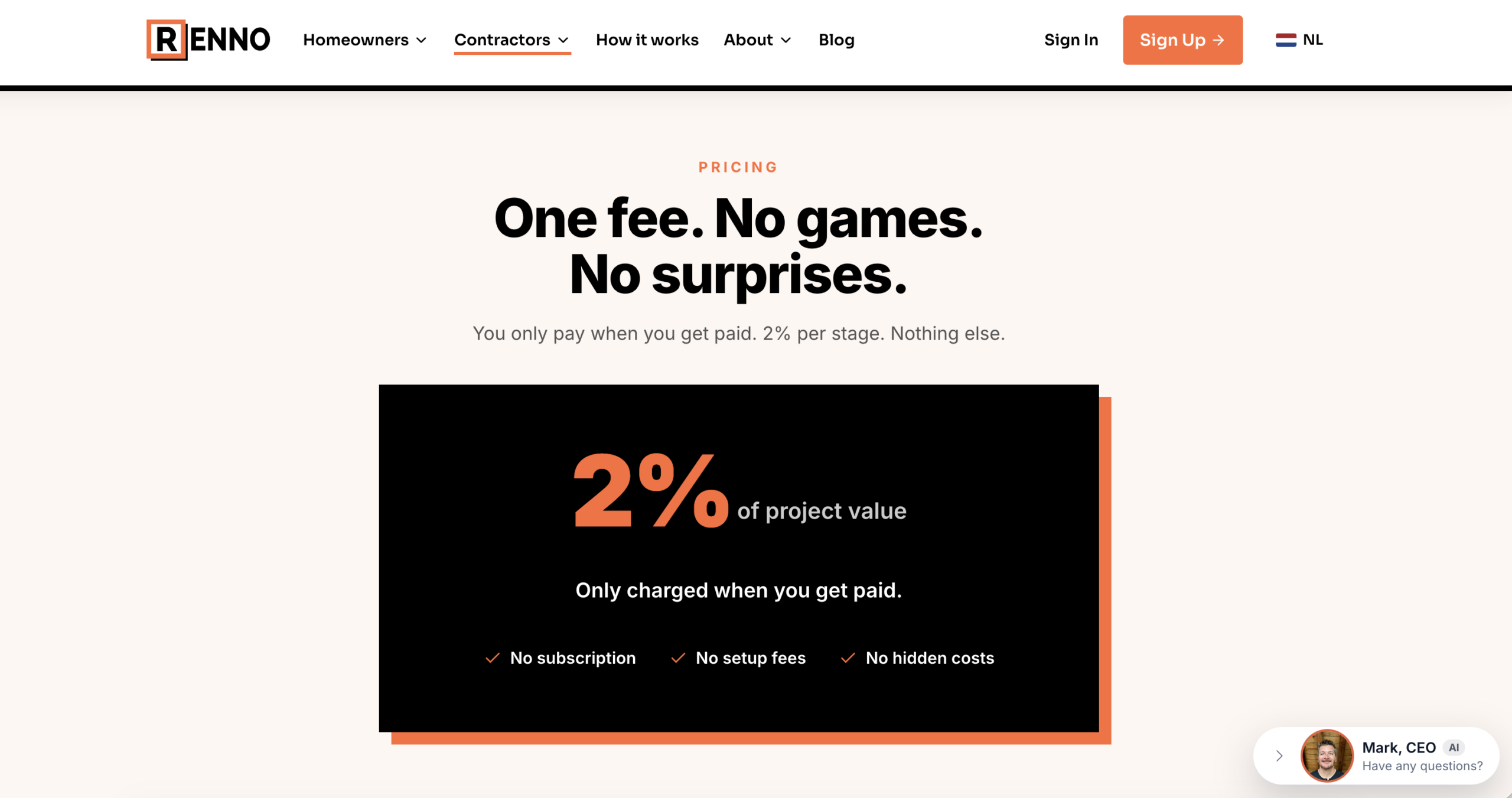
Only the builder pays, a 2% project fee, which I wondered about. I asked Mark whether builders push back on that. He says it’s been a non-issue, because they mark it up for the client. A 50,000 euro kitchen becomes 51,000, or they list it in their agreement as the Renno fee.
What did come up early on was a different worry. Some builders thought they would have to pitch a fintech to their clients on top of selling the job. Renno told them not to. They just tell the client this is how they get paid, and point them to Renno with any questions. Renno takes over the client side of the experience on the builder’s behalf.
Renno goes into new markets city by city, with what Mark calls an Uber-style pod approach, aiming for the top three to five cities in each country. It also works with popular construction creators on social media, and Mark says one recent post got around 450,000 impressions and interactions.
The most unusual channel is the one Mark says his investors laugh at. Early in the summer he was fed up with the Meta ad bill against what it converted, so the team asked where builders actually are: on job sites, with their branding on their vans and scaffolding. They couldn’t walk up to everyone, because “they’ll throw a hammer at us if we try and pitch them a fintech.” So they put a 360-degree camera on a colleague, put him on an e-bike and sent him around the Amsterdam canal belt, where most of the projects were running.
The footage was stripped down and Claude built a dossier on each builder from the Dutch company register, social media, ads and permits, which went into Renno’s HubSpot. Then came a WhatsApp message or a personal call: we saw you working on that canal, we have clients in this range, can we introduce ourselves? The cost of a lead fell from three or four hundred euros to one or two. Mark calls it “not scalable, but it works really well.”
How does Renno use customer feedback to shape its product?
Mark says the thing he’s most focused on today is feedback loops: are there enough of them out there, are they wide enough, is the information coming back, and is Renno acting on it fast enough? Internally, the thesis is that they’re “probably half right each time” and just need to keep getting a little more half right, as fast as they can.
The product team spends most of its time on interviews and user research with both sides, clients and builders. Mark says that has built up a rich database, so when product and engineering think about changes there’s “not a lot of just guessing.” He compares it to a pipeline: just like recruiting or sales, you have to keep working it months before you actually need it.
It applies to positioning too. The builder side is very diverse: a one-person band, a company running 50 people, one operator with 5 million in revenue a year from just three projects, another with 600,000 across 90 small ones. Speaking to all of them at once is hard, and Mark says they “still haven’t nailed it.” Marketing walks a tightrope as well. The company started because trust between the two sides had broken down, and it has to tell the trust story without making the other side the boogeyman.
That work turned up a surprise. Builders were more hesitant than expected to put a payment tool in front of their clients, even though you’d think getting paid faster is a no-brainer. Homeowners were more willing than expected to put one of the larger sums they’ll ever spend with a builder into an app they don’t know.
How do milestone payments work on a Renno project?
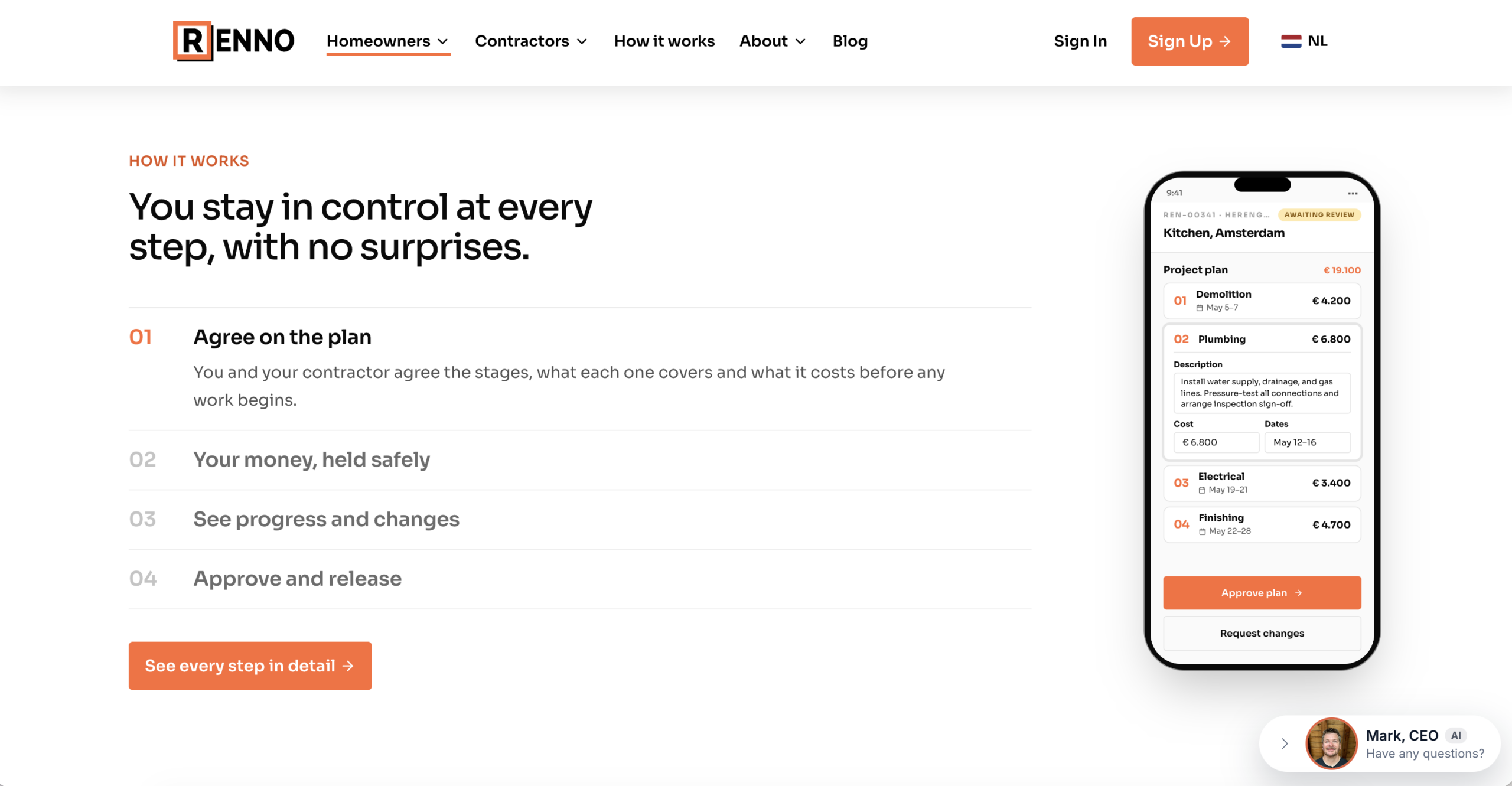
Here’s how it works. The homeowner puts the money for the project into an account held in their name with a regulated payment partner, ringfenced for that job. The builder can see the money is there. The quote is split into milestones, and when one is done the builder submits video and photos. The homeowner, or a quality surveyor, approves the work and the money is released instantly. Mark’s picture of it: the builder’s phone buzzes with the payment before they’re back at the van. Builders often take a 20 to 30% deposit as an insurance policy. With Renno they can also see the full project is funded, and get paid stage by stage.
Change orders are where a lot of disputes start, and Mark says every project has one. You open a wall, you find mould, a specialist has to come in and it’s an extra 2,000 euros. Outside Renno that conversation usually gets tacked on at the end, and one side remembers 2,000 while the other remembers 200. On Renno it’s agreed and funded right there, as a new milestone.
If a milestone is disputed, Renno encourages the homeowner and the builder to go back and forth twice on their own: the client points out what’s missing, the builder fixes it. By the third time, a person at Renno steps in, from a concierge team of former project managers and general contractors who can read plans. If they can’t sort it out in about five minutes, Renno brings in an independent third party whose decision is binding, an electrician for electrics or a structural engineer for a door frame, and the two sides split the cost. That’s in the terms and conditions.
Mark also talks about how people behave differently. Because the homeowner has already put the money in, approving a milestone feels more like a release than a payment. Because the builder can see the money, there’s no question mark over it. Renno is the “third eye in the sky,” and Mark says that because it’s there, both sides tend to behave a little bit better. His aim is to “make both sides the good guys for each other.”
Where is Renno expanding next?
The Netherlands is where Renno started, and the UK is quickly becoming its primary market. Next up are France and Germany, around the middle of 2027, with Spain and Italy soon after. Mark says there’s no real limitation from financial or construction regulations. It’s more about entering each market with the right people and capital committed.
One thing is already live. Renno has opened a homeowner concierge, which it doesn’t charge for yet. It’s staffed by former builders and project managers who have spent time on hundreds of sites, and it helps homeowners who have the funding and are ready to go but aren’t sure what to do: finding the right builders, comparing quotes, knowing what to look for. Mark says it has created an avalanche of inbound that Renno has been converting.
Around the turn of the year, Renno has something new coming for builders. Today it’s very much one builder, one job at a time, helping money come into the business. Soon it will help with money going out too, and with the day-to-day running of the business. Mark puts the mission like this: “the Revolut of construction,” or the “financial central nervous system for construction SMEs.”
Mark’s own banking is what convinced him there’s room here. He has around eight accounts across ABN Amro, Revolut, bunq and the high street banks, and can’t see what’s different about any of them. He thinks most people feel the same, and that a bank built for the trade, with cashback and benefits that strengthen the business, could peel builders away from the high street.
Why can a vertical player win here? Depth, according to Mark. A horizontal bank like Revolut, bunq, Monzo or even Lloyds won’t go that deep into one trade. But first, he says, trust is the harder hurdle to clear. If builders trust Renno with their cash flow, which is the lifeblood of their business, it can offer other financial products they’re already using, often at what he calls quite predatory rates, and the relationship gets stickier.
What can vertical fintech founders learn from Renno?
Renno started with the thing that hurts both sides most: money changing hands on trust. Everything else follows from that. Builders, who come back job after job, pay the fee. Homeowners, who show up with the cash, bring in the next jobs. And the feedback from both keeps making it better.
Listen to the full conversation on Tenity Fintech Makers
Are you building a verticalised fintech, or a vertical operating system that fintech can layer into? We’d like to hear from you.
Disclosure: Renno is a Tenity portfolio company.