
Companies enter African markets by starting with one country, not the entire continent. During the Tenity Africa Market Access webinar, experts emphasized that Africa is made up of 54 distinct markets, each with its own regulatory framework, currency, and business culture. Successful entry typically involves building strong local partnerships, understanding regulatory requirements, and establishing trust before scaling regionall


















African Market Entry: A Practical Guide for Startups, Corporates, and Investors
A practical guide to market access in Africa based on expert insights from the Tenity Africa Market Access webinar. Learn entry strategies, challenges, country differences, scaling models, and common mistakes when expanding into African markets.
African market entry is one of the most frequently discussed — and most frequently mishandled — expansion strategies in fintech and technology. Africa is frequently described as “the next growth frontier,” yet for companies planning African market entry, the reality is far more nuanced than headlines suggest. This guide is based on expert insights from the Tenity Africa Market Access Webinar, where leading investors and ecosystem operators discussed what works — and what doesn’t — when expanding into African markets.
Africa is not one market
The first and most important insight is structural: Africa is not a single market. It is 54 countries, each with distinct regulatory systems, currencies, political environments, and cultural dynamics. One of the biggest mistakes foreign companies make is treating Africa as a homogeneous expansion region. Unlike the European Union, there is no uniform regulatory framework across the continent. Currency volatility varies by country. Business culture differs significantly between Nigeria, Egypt, Morocco, and Kenya, for example.
Successful expansion begins with selecting one market — not “Africa” as a whole.
How do companies enter African markets?
There is no universal entry model. However, most successful companies follow one of these approaches:
Corporates often choose a local partnership model, working with established players who already understand regulatory frameworks, cultural nuances, and decision-making hierarchies.
Scaleups typically pursue a subsidiary setup, establishing a local operating entity within a target country. This offers more control but requires careful navigation of regulatory complexity, licensing requirements, and compliance obligations, which differ significantly by country.
VC-backed startups frequently expand through a structured growth model aligned with investor expectations. Expansion decisions are closely tied to exit visibility, governance structures, and holding company jurisdiction. Investors increasingly expect clarity on how regional expansion supports long-term liquidity pathways.
Fintech and technology companies often adopt a regional hub strategy, entering through gateway markets such as Morocco, Egypt, Nigeria, or South Africa before expanding further. These markets typically offer stronger infrastructure, capital concentration, or geographic access to neighbouring regions.
Many venture-backed startups choose to establish a holding entity in jurisdictions such as Mauritius, the UK, UAE, or Delaware — often driven by investor requirements related to taxation, governance, and capital repatriation — while keeping operations fully on the ground within African markets.
Across all models, one insight remains consistent: speed alone does not determine success. Trust, local credibility, and structural preparedness matter more than rapid expansion.
Best market entry strategies for Africa
From investor and ecosystem perspectives, the strongest strategies share several characteristics.
Start hyperlocal. Rather than expanding regionally too early, successful companies focus on deeply understanding one market: its regulators, customer behavior, pricing sensitivity, and competitive landscape.
Prioritize sustainability over hype. In the early 2020s, abundant capital encouraged growth at any cost. Today, investors are significantly more disciplined — “less hype, more unit economics” was a recurring theme. Companies must demonstrate strong gross margins, a clear path to profitability, sustainable customer acquisition costs, and resilience against currency devaluation.
Address governance and corporate structure early. Many investors expect holding companies to be incorporated in investor-friendly jurisdictions such as Mauritius, the UK, or the UAE, while operational entities remain on the continent. Clear governance, compliant structures, and transparent ownership models significantly increase investability and reduce friction during fundraising or exit discussions.
Secure access to decision-makers. In many African markets, top-level relationships drive transactions. While product quality is critical, deals often depend on credibility, trust, and direct engagement with executive leadership or regulators. Market access is rarely purely transactional.
What are the biggest market access challenges in Africa?
The challenges companies face are structural rather than opportunity-driven.
Currency volatility remains one of the most significant risks. Devaluations in markets such as Nigeria or Egypt can dramatically affect pricing models and margins if not properly structured.
Regulatory fragmentation adds complexity. Each country requires specific compliance frameworks, licenses, and relationships — there is no continental shortcut.
Trust-based business culture is another defining feature. Relationships often precede transactions. Unlike purely digital-first Western markets, credibility and on-the-ground presence significantly influence deal flow.
Liquidity remains a central ecosystem question. Exit pathways are still developing, and investors increasingly evaluate expansion plans based on realistic acquisition or secondary exit potential within fund timelines.
Africa does not lack opportunity. It lacks uniformity.
Common mistakes when entering African markets
Experts highlighted several recurring mistakes. The most damaging is treating Africa as one homogeneous market. Closely related is applying a Silicon Valley “move fast and break things” mentality, which tends to erode trust rather than build it. Other frequent errors include underestimating cultural nuance, ignoring FX risk, prioritizing growth before profitability, and attempting remote expansion without local presence.
In Africa, speed without trust can permanently close doors.
Which African countries are easiest to enter?
There is no universal “easiest” market. However, certain countries are frequently used as entry points.
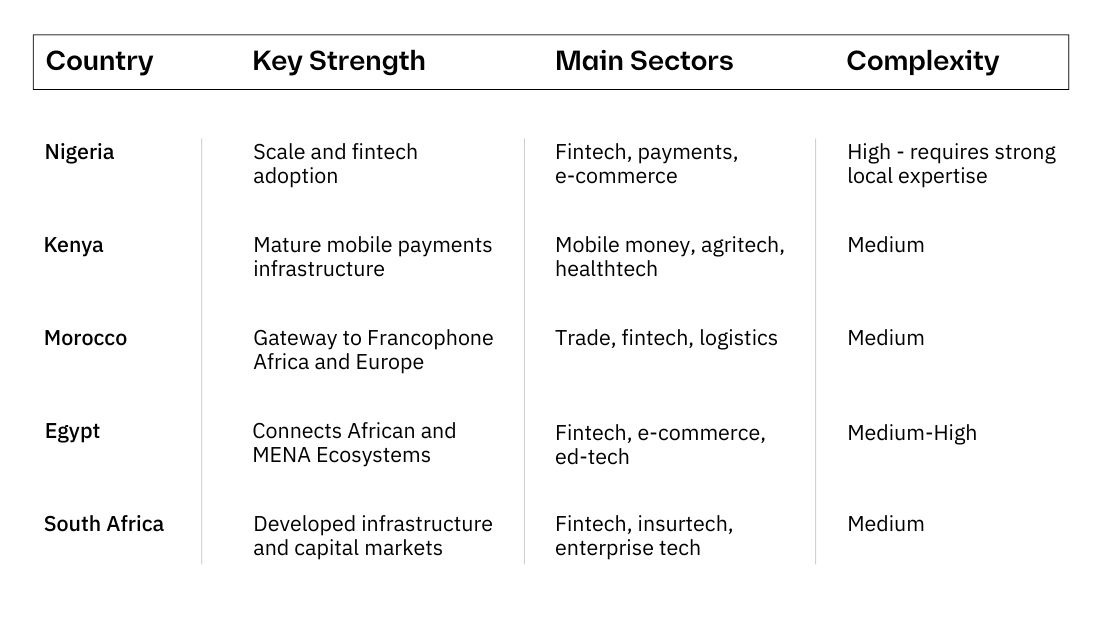
How to scale a business in Africa
Scalability in Africa is often misunderstood.
Economic instability does not prevent scale: poorly structured models do. Companies that succeed build resilience into their business architecture from the start: localized compliance knowledge, FX resilience, infrastructure awareness, long-term partnerships, and clear unit economics. Scalability requires balancing growth with structural stability.
What investors look for in African market expansion
From a venture capital perspective, investors assess founder quality and resilience, depth of local market knowledge, governance and team composition, realistic exit pathways, unit economics discipline, and timing and regulatory readiness. The narrative alone is insufficient. Investors increasingly demand execution capability and long-term alignment.
Why this matters for Tenity
Entering African markets requires ecosystem intelligence, not just capital. Tenity connects startups, corporates, investors, and regulators across markets enabling strategic expansion rather than speculative entry.
Ready to enter African markets? Scale your startup — talk to us
About the panelists:
Kaan Akin — Partner at Tenity (Moderator)
Eda Taskin — Tenity, Global Market Access Series
Uwem Uwemakpan — Launch Africa, Head of Investments
David van Dijk — Boost Africa, Team Lead
Olamide Ogunrinola — OPUS Network, Head of Investment Ecosystem
African Market Entry: Frequently Asked Questions
How do companies enter African markets
What is the best market entry strategy for Africa?
The best market entry strategy for Africa is to start hyperlocal and prioritize sustainability over rapid expansion. Investors highlighted that companies should deeply understand one market before expanding. They also stressed the importance of strong unit economics, governance structure, and timing. Expansion should not be driven by hype but by structural readiness and long-term viability.
What are the biggest challenges of market access in Africa?
The biggest challenges of market access in Africa include regulatory fragmentation, currency volatility, and trust-based business dynamics. Each country operates differently, and companies must account for foreign exchange risk and infrastructure readiness. Experts also noted that liquidity and exit pathways remain important considerations for investors.
Why do companies fail when expanding into Africa?
Companies often fail when they treat Africa as a single homogeneous market or attempt to expand too quickly. During the webinar, speakers cautioned against applying a “move fast and break things” mindset in trust-driven environments. A lack of local credibility, insufficient regulatory understanding, and unrealistic growth expectations were identified as common causes of failure.
What do investors look for in Africa market expansion?
Investors look for founder quality, governance structure, realistic exit pathways, and strong unit economics. Rather than prioritizing rapid growth, investors now focus on sustainability, path to profitability, and resilience to currency fluctuations. Expansion strategies must align with long-term liquidity expectations within fund timelines.
Should startups domicile outside Africa when expanding?
Many venture-backed startups establish holding companies in investor-friendly jurisdictions such as Mauritius, the UK, or the UAE, while maintaining operational entities within African markets. This structure is often driven by investor requirements related to governance, taxation, and capital repatriation.
Is Africa ready for technology scale?
Experts agreed that Africa remains an early-stage ecosystem but is evolving rapidly. Infrastructure improvements in payments systems, fiber connectivity, and open banking initiatives are accelerating opportunities. However, scalability depends on disciplined execution, local market understanding, and structural resilience.